Showing posts with label google. Show all posts

Thursday, February 01, 2007

Blogger labels and Technorati tags

Several weeks ago I've upgraded my blog from the old blogger interface to the new one. It was quite painful at the time, but hey, how can I not try a new toy.

The new blogger interface supports tags labels. The labels are even marked with the Rel-Tag microformat.

Too bad that the migration process did not migrate my Technorati tags (which are also marked with Rel-Tag) to Google labels. It would have been a considerate move on Google's part, especially when they took their time adding this now-standard rel-tag support.

So, I went and manually edited the older posts, copying the Technorati tags to that nice comfy Labels box.

And now Blogger is republishing my entire feed.

Oh well. Sorry for the mess!

Thursday, October 26, 2006

Popup menus - Flickr vs. Google

A few weeks ago Google quietly opened up SearchMash.com.

While SearchMash is not branded with the Google brand, the fact that it is being operated by Google was quickly revealed and widely discussed:

(The lack of branding was explained by Google as an attempt to gather more objective data about user response to new interfaces).

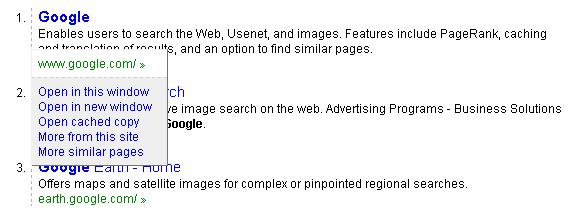
The most surprising change for me was the behavior of the green link:

Screenshot: Google SearchMash search results
Since it looks like a link, and smells like a link, you'd probably expect it to - duh - behave like a link, and take you to the web page it points to.

This is not the case in SearchMash though. When you click on the green link, you get a *gasp* popup menu with options:

It's interesting to compare this to the approach taken by Flickr in their recent user interface revamp.

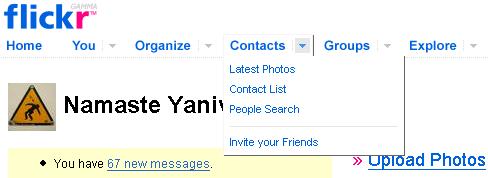
Looking at the menu toolbar on the top of the Flickr page, you'll notice a list of links, and a small arrow next to each one of them:

Now, it's interesting to note that unlike the Google interface, which sacrifices old habits to provide richer functionality, the Flickr menu manages to provide the richer functionality while retaining the class link semantics and behavior.

When you click the arrow, a drop-down popup menu opens up with a list of options:

Which is great. But, if you didn't notice the arrow, or you don't understand what is it supposed to do, you can simply click the link:

What's really nice though, is that once you click the link, you get the Latest Photos page - but you also get the same list of links which were in the popup menu listed at the top row of this page, so you're still able to navigate to them.

I find the Flickr choice of user interface a much better balance between retaining compatibility with existing habits and known metaphors, and providing new functionality.

Thursday, August 17, 2006

Google search results - link tracking costs 90 Gigabytes / day

I spent a few minutes, together with Eran, looking at the method that Google uses to track which links are clicked in the Google search results page. I figured they must be doing this, since it sounds like an essential bit of information, and of course they do that.

The mechanics are simple, and very well implemented - the generated links in the search results have a onmousedown JavaScript function (named clk) attached to them. When a link is clicked this JavaScript bit is run. Essentially what it does is use the JavaScript Image object (one of the oldest tricks in the JavaScript "book") to send a request to the Google web site, with the clicked link information:

function clk(url,oi,cad,ct,cd,sg) {
...
new Image().src="/url?sa=T"+oi_param+cad_param+"&ct="+e(ct)+"&cd="+e(cd)+u+"&ei=jwbkRLWWGYfa2wKN1uRj"+sg;
}

I was surprised though to find in that otherwise-sparkling-clean Google implementation a bunch of additional JavaScript functions which appears to be never used, like:

function ss(w,id){window.status=w;return true;}
function cs(){window.status='';} var bdg = 0;
function sb() {bdg = 1;}
function ga(o,e)
{
...
}
function anbc(id)
{
...
}

A quick count of the bits shows that the unused JavaScript code amounts to about 1K in size, per search results page. Assuming 91 million searches per day, this means unnecessary waste of 80-90 Gigabytes (depending on how you count MB - the right way or the Western Digital way :) ) of bandwidth, every day.

It's a good thing that bandwidth is so cheap. If Google was running on GoDaddy, they'd consumed their entire $10/month 500GB bandwidth limit in 6 days :)

And no, please don't count how much bandwidth we waste on unnecessary JS in the Yedda pages, I can tell you right away it's quite a bit. Functionality first, optimizations later!

Technorati : , , , , ,
Del.icio.us : , , , , ,

Thursday, March 09, 2006

Web 2.0, kicking even harder

The local Web 2.0 scene is heating up. Following the Gemini Internet event on January, the informal lunch with TechCrunch's Michael Arrington two weeks ago was another trigger in getting us Israeli web entrepreneurs talking to each other, and trying to form local "support groups". The lunch event was covered in a TechCrunch post (see also Valleywag's slightly different interpretation :), and later by the local Ilana Tamir on the Nana portal (Hebrew. I was interviewed for this one).

Another nice development is the introduction of the.co.ils (Hebrew), by Yaron Orenstein and Yemi Glick, both internet veterans. ("co.il" is Israeli commercial domain name, equivalent to .com). the.co.ils is an independent blog aiming to cover the local 'net-related initiatives - existing and new. It's young (3 days old...) and fresh and looking good!

Plus, Google is opening its first Middle East R&D center in Haifa, Israel. Yes, things are heating up.

By the way, "Valley" in Hebrew is emek, and "Silicon" is tzoran. This knowledge may be useful one day :)

Technorati : , , , , , ,
Del.icio.us : , , , , , ,

Wednesday, December 14, 2005

GDoom anyone?

Off topic.

Google released the API to add widgets modules to the Google personalized homepage.

Naturally, one of the first widgets modules made available is "Eyes".

We've all been through this before, so many times. We all know where it leads to:

New Platform -> New Windowing System -> New Widgets Framework (yes! widgets! not modules! and while we're at it -also tags, not labels. ) -> A Port of Eyes -> A Port of Doom.

Is anyone working already on a port of Doom to run inside the Google personalized homepage??

Technorati : , , , , , ,
Del.icio.us : , , , , , ,

Sunday, December 11, 2005

Yahoo Answers

Yahoo launched Yahoo Answers on Wednesday - this is almost old news :)

Yahoo Answers is a service with a simple and compelling objective - allow any (Yahoo) user to ask any question and get an answer from other (Yahoo) users.

The service was first announced without too much fanfare on the Yahoo! search blog, by Jeremy Zawodny.

Personal disclaimer: [stealth mode. If you really have to know feel free to ask.]... having said that:

Yahoo Answers is slick and easy to use... the user scenario is simple and straightforward: join the service, ask your question, add details, categorize the question, and post it away.

A points system throttles a user's usage of the service, with points awarded to actions ranging from mere participation (login into the service and you get 1 point), to having your answer voted as the best answer (10 points). The more points you have, the more you can participate (ask, answer, vote and rate). Somewhat similar to the original experts exchange points system, and somewhat counter-Web 2.0-religion, as it potentially limits user's ability to co-create and to contribute value to the service.

From the bells and whistles area, RSS feeds are available for categories, questions and users, but tagging is very much absent - a point noted by many of the reviewers. Instead, Yahoo provided a taxonomy / hierarchical categorization system. Interesting choice, given Yahoo's leadership in the tagging area (Flickr, Del.icio.ous, My Web 2.0). And a choice that will limit the service ability to leverage the long tail of knowledge, since it forces the questions into the mainstream topics, exiling all niche questions into the "Other" category.

Yahoo Answers is not the first attempt at this. In fact, Susan Mernit referred to it as a YAAN - Yet Another Answer Network, comparing it to Wondir and to others. While it's true that Yahoo Answers is not much different then Wondir, which has been around for quite some time, the user experience in the Yahoo implementation is considerably more slick, and is likely to get better and better. Not to mention the fact that, not really surprisingly, Yahoo Answer got on its first day traffic similar to what Wondir is seeing after ~3 years of operation.

Which does make me wonder - what's going to happen if Yahoo Answers turns out to be really successfull? Let's say that I am interested in answering questions in a specific category. Browsing through categories is fine as long as there are a few hundred questions in each one. Subscribing to a category makes sense if it gets 20-30 questions a day. But what do you do when you got 100K questions per category? Thousand of questions in each category per day?

How do you make sure that askers experience a reasonable "SLA" - or satisfaction level - meaning, have most of their questions get reasonable answer in a reasonable timeframe?

To survive the potential onslaught of Yahoo's 82M users, the service will need either a more effective way for answer-providers to easily find questions relevant to them, or a more convincing incentive system. Or, better yet, both :) Without these, the differentiator between this service and any other mega-bulletin-board is not clear.

As noted in SearchEngineWatch's review of Yahoo Answers, spam, scams, blatant advertising and other forms of abuse could turn out to be a problem in such a system. Looks like Yahoo is hoping that the points system, combined with community filtering and the need for a Yahoo ID, will reduce this to a manageable level. The exploitable areas in the system are quite obvious - for a second I thought about listing them, but on second thought, maybe it'd be wiser to let spammers come up with that list on their own :)

Like Wondir, Yahoo Answers suffers from the "initial impression" effect (we call this "The Harry Potter Effect" - whenever a new Harry Potter book is released, Wondir is swamped with Potter-related questions...) - when a user enters the system and is exposed to the "most recent" questions list, the content of these questions determines the flavor of the service in the eyes of the user. And given the random nature of this most recent list, and the topics which people are most interested at, that initial impression may cause users who are valuable knowledge sources to click-back-away. Again, if leveraging the long tail of knowledge is a goal of the service, thought should be given to this topic as well.

Yahoo is probably leveraging lessons it learned from observing similar services from its competitors in Korea, where one of the top portals provides a successfull similar service that integrates Yahoo Answers-like "knowledge search" into the search and commerce experience. It's clear though that the success of such a service depends on cultural factors which may be very different between the Korean and the US markets. One notable point is the fact that in the Korean implementation, the sign in into the system is using the user's social security number, making the reputation system considerably more attractive.

It's interesting to note that at pretty much the same time, Answers.com, a Google's partner, announced that it will buy Brainboost, a service that relies on an algorithm nicknamed AnswerRank™ to extract answers from existing web pages. Again, a demonstration of the people empowering through the machine vs. people empowering through people approach. Google also offers its own take on the issue with Google Answers, a service that provides answers from a selected small group of pre-screened researches for fee, where the fee is determined through bidding.

Here are some interesting reviews on Yahoo Answers:

  • Barb Dybwad, on thesocialsoftwareweblog, discusses the challenges that Yahoo Answer will face with regards to reputation, scams and infomercials
  • Michael Arrington on TechCrunch discusses the service and complains about the categorization system
  • Michael Parekh compares Yahoo Answers with Google Answers
  • Susan Mernit compares Yahoo Answers with Wondir, 43 things and Squidoo
  • Gary Price published on SearchEngineWatch a 2-part in-depth, fascinating review
  • Michael Bazeley published on SiliconBeat an interview with Ofer Shaked and Caterina Fake of Yahoo, in which Shaked mentioned that Yahoo is looking at letting posters tag their question
  • Pete Cashmore published on Mashable interesting thoughts on the merits of the Yahoo Answers points system


Technorati : , , , , , , , , ,
Del.icio.us : , , , , , , , , ,

Saturday, December 10, 2005

y.ah.oo!

Yahoo! acquired del.icio.us yesterday, proving once again that among the big 4, they are the one who actually "get it".

Joshua's announcement on del.icio.us was aptly titled "y.ah.oo!".

They couldn't have made a better choice of course. Despite its often-discussed shortcomings, and maybe somewhat because of them, del.icio.us has the liveliest, most vibrant and active community from the social bookmarking crowd. The gentleness track record that Yahoo demonstrated with Yahoozation of Flickr might help making sure that this community won't walk away.

Walking away should be a real concern - since switching from one social bookmarking service to another is very, very easy today.

Reminder: Yahoo introduced their own del.icio.us-like service, My Web 2.0, not so long ago. The service was not as successful as you'd expect, with "only 424K saved pages and about a quarter of that in tags". I said back then: "… might save a lot of time in those VC weekly investment committee meetings". I guess that was somewhat premature :)

It'd be interesting to see what will the result of this ongoing process - the Flickrization of Y.ah.oo!. One thing is sure - with so many tagged web objects, and, even more important, so much information on which users act as a de-facto authority on what's interesting, Yahoo!'s search engine should get quite a boost in the relevancy of its results.

Now that my photos are on Yahoo's Flickr and my bookmarks on Yahoo's del.icio.us, will Yahoo be able to get me - and, slightly more important, others :) - to move from typing "google" when I think web search to typing - hmm... what is the URL for Yahoo's search thingie? Maybe I should start memorizing it..

There is something poetic about this battle between the two giants, with one betting on algorithms and server farms, and the other betting on people.

A different way to look at it: Google is about empowering people through the machine. Yahoo is about empowering people through people, with the machine as an aggregator. Oh yeah, and Amazon, making an attempt at empowering the machine through people :)


Technorati : , , , , , , ,

Del.icio.us : , , , , , , ,

Tuesday, December 06, 2005

Google Beware

And now for something completly different:

Quantum Entanglement is the new Search. At this point it's good mostly for 2-bit searches, but hey, it's a start.


Technorati : , , , ,
Del.icio.us : , , , ,

Saturday, December 03, 2005

Google anyone?

There is one player notably missing from the social bookmarking, and that's Google.

2 years ago there were rumors that Google tried to buy Friendster, and shortly after Google introduced orkut.

Google's Personalized Search, introduced on Nov '05, does bookmarking with tags (oops, labels in Google-talk) as a sidekick. But these tags labels are personal, not "social" - they cannot be shared with the community.

How come?

Either Google believes that its algorithms can do just fine (or be further improved) without the need for human input, or, maybe they believe that they can simply leverage the social tagging done by other non-Google services (which, after all, result in links- the fuel for Google's PageRank algorithm), or maybe something is cooking.

It's interesting to note that Google has a patent that covers certain aspects of social bookmarking:

[0068] In one embodiment, a user may share or overlay bookmarks. For example in one embodiment, a user is able to open up their bookmarks for others to view.

also:

[0069] One embodiment of the present invention fosters community and relationship building. In one embodiment, the search engine is able to recognize clusters or pairs of users having similar interests.

Rumors anyone?


Technorati : , , ,
Del.icio.us : , , ,

Wednesday, November 16, 2005

All Your Base

Now that Google Base was launched, we will be seeing a revival of the "All-Your-Base" wave. So, here is some useful background :) (thanks Daniel)

Technorati : , , ,
Del.icio.us : , , ,

Thursday, November 03, 2005

The Answer to Life, the Universe, and Everything

Osher Frimerman just pointed out that the numerical value of the word Google, as written in Hebrew, is... yes. 42.

Hmpff :)


Technorati : , , , ,
Del.icio.us : , , , ,