Showing posts with label flickr. Show all posts

Sunday, January 28, 2007

Flickr Machine Tags

Flickr recently announced a new feature called "machine tags". From their announcement:
"Machine tags" is the technical term for the extra hamsters we've added to the Flickr servers to formalize how these sorts of tags are treated. I've included a "Ceci n'est pas un FAQ" below with all the details.
Machine tags follow a lightweight format:

namespace
:predice=value
The namespace defines a class or a facet that a tag belongs to ('geo', 'flickr', etc.) The predicate is name of the property for a namespace ('latitude', 'user', etc.) The value is, well, the value.

Like tags, there are no rules for machine tags beyond the syntax to specify the parts of a machine tag
Tags that follow this format are automatically grouped under "machine tags" in the Flickr user interface, and can be hidden or shown by the user.

Machine tags, while not having a name, have been around for a while, their usage driven by people's urge to organize tags and give them specific semantics - and then, to build applications on top of this, assuming this specific semantics. I've discussed this a while ago, when I was younger. Back then, I suggested the name "applitags" for this feature, and suggested a slightly different format for differentiating Machine Tags (or applitags) from People Tags:

x:namespace.tag[=value]

I do wish the Flickr folks would have gone a step further and formalized the namespacing issue as well, as this would have made software built on top of Machine Tags more reliable. Still, this is an important move, coming from one of the tags-trend-setting players.

Are we re-building XML from the ground up all over again though?

Technorati Tags:

Tuesday, November 14, 2006

Yes, I pay for two Flickr accounts!

Three actually, if you also count the Yedda one.

The question of my multiple Flickr accounts came up several times in the last few weeks, in conversations with Eszter Hargittai, Deb Schultz, Ned Rosen and Lilly1975. I also happened to meet Caterina Fake last week, and when I mentioned to her that I am paying "her" for 3 different Flickr accounts, it seems a bit excessive even to her :)
The Flickr of the Smiles

You see, I really got into amateur photography this past year. I found that I really enjoy it, even just going on my own to shoot urban scenes for a few hours gives me immense pleasure. I also enjoy sharing it and interacting over it, which is what I do through my yanivg Flickr account. I shoot a lot, probably a few hundred pictures every week or two. I pick the ones I really like (usually from a photography point of view) to post to this account. The sets I use on this account are "thematic" – urban, people, reflections, etc.
text decay

Me enjoying photography also surfaces when I attend (un)conferences or other social-work-related events. I tend to bring my cam along with me to many of these events, and these photographs usually have a documentary / networking / social value rather then photographic value. I post these pictures to my yghelloworld Flickr account. The sets on this account usually represent specific events.

A lot of the people I know on Flickr actually freely mix the two, posting to their photostream pictures a mixture of their personal life, their professional life, and pics they just happened to like.

It may be somewhat of a vanity issue, but I hate the thought of flooding my carefully-tended yanivg photostream with tens of pictures of *gasp* people. The downside of it is that it creates a sort of a split-personality issue.

For me, my yanivg photostream is as far as I go with regards to displaying my photographic work. Contrast this with Ned for example, who makes his living from photography, and for him, Flickr provides a liberating alternative, where he can share personal stuff and work-in-progress, and document the process evolution as opposed to the final polished customer-ready result.

I guess that in a way this is the beauty of an open-system ended like Flickr. Flickr is a playground with basic building blocks (photos, photostream, tags, groups, sets), and each user is free to put meaning into this, and people from different disciplines and with different goals can still meet on a common ground.

It's interesting to compare that with, say, the newly-launched Six Apart VOX approach, which uses the notion of "neighborhood", hence defining a fixed terminology and meaning. Will "neighborhoods" work better then the generic "groups"?

Thursday, October 26, 2006

Popup menus - Flickr vs. Google

A few weeks ago Google quietly opened up SearchMash.com.

While SearchMash is not branded with the Google brand, the fact that it is being operated by Google was quickly revealed and widely discussed:

(The lack of branding was explained by Google as an attempt to gather more objective data about user response to new interfaces).

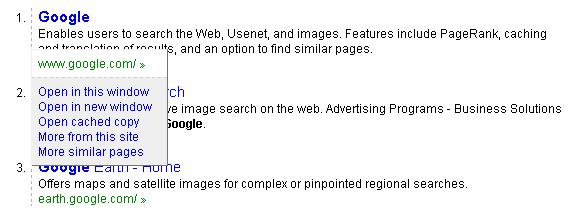
The most surprising change for me was the behavior of the green link:

Screenshot: Google SearchMash search results
Since it looks like a link, and smells like a link, you'd probably expect it to - duh - behave like a link, and take you to the web page it points to.

This is not the case in SearchMash though. When you click on the green link, you get a *gasp* popup menu with options:

It's interesting to compare this to the approach taken by Flickr in their recent user interface revamp.

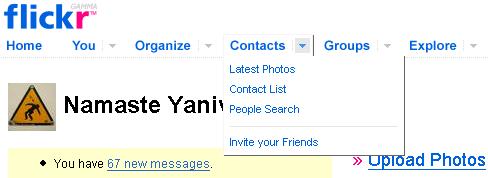
Looking at the menu toolbar on the top of the Flickr page, you'll notice a list of links, and a small arrow next to each one of them:

Now, it's interesting to note that unlike the Google interface, which sacrifices old habits to provide richer functionality, the Flickr menu manages to provide the richer functionality while retaining the class link semantics and behavior.

When you click the arrow, a drop-down popup menu opens up with a list of options:

Which is great. But, if you didn't notice the arrow, or you don't understand what is it supposed to do, you can simply click the link:

What's really nice though, is that once you click the link, you get the Latest Photos page - but you also get the same list of links which were in the popup menu listed at the top row of this page, so you're still able to navigate to them.

I find the Flickr choice of user interface a much better balance between retaining compatibility with existing habits and known metaphors, and providing new functionality.

Thursday, February 09, 2006

Web 1.0 logos

Stabilo Boss (?) posted to Flickr an image incorporating the logos on most of the Web 2.0 companies out there (yes, Yedda is there too! with the old logo though, instead of the cool new one).

Complexify responded with a link to his collection of "Web 1.0" logos, straight out of '99.

A quick look at these two images was enough to reach a clear conclusion - at the very least, from a graphic design point of view, Web 2.0 is a lot nicer :)

Technorati : , , , , , , ,
Del.icio.us : , , , , , , ,

Saturday, December 10, 2005

y.ah.oo!

Yahoo! acquired del.icio.us yesterday, proving once again that among the big 4, they are the one who actually "get it".

Joshua's announcement on del.icio.us was aptly titled "y.ah.oo!".

They couldn't have made a better choice of course. Despite its often-discussed shortcomings, and maybe somewhat because of them, del.icio.us has the liveliest, most vibrant and active community from the social bookmarking crowd. The gentleness track record that Yahoo demonstrated with Yahoozation of Flickr might help making sure that this community won't walk away.

Walking away should be a real concern - since switching from one social bookmarking service to another is very, very easy today.

Reminder: Yahoo introduced their own del.icio.us-like service, My Web 2.0, not so long ago. The service was not as successful as you'd expect, with "only 424K saved pages and about a quarter of that in tags". I said back then: "… might save a lot of time in those VC weekly investment committee meetings". I guess that was somewhat premature :)

It'd be interesting to see what will the result of this ongoing process - the Flickrization of Y.ah.oo!. One thing is sure - with so many tagged web objects, and, even more important, so much information on which users act as a de-facto authority on what's interesting, Yahoo!'s search engine should get quite a boost in the relevancy of its results.

Now that my photos are on Yahoo's Flickr and my bookmarks on Yahoo's del.icio.us, will Yahoo be able to get me - and, slightly more important, others :) - to move from typing "google" when I think web search to typing - hmm... what is the URL for Yahoo's search thingie? Maybe I should start memorizing it..

There is something poetic about this battle between the two giants, with one betting on algorithms and server farms, and the other betting on people.

A different way to look at it: Google is about empowering people through the machine. Yahoo is about empowering people through people, with the machine as an aggregator. Oh yeah, and Amazon, making an attempt at empowering the machine through people :)


Technorati : , , , , , , ,

Del.icio.us : , , , , , , ,

Tuesday, November 15, 2005

The Flickrization of Yahoo

Erick Schonfeld wrote in Business 2.0 about the effects of the Flickr purchase on the Yahoo culture, and Yahoo's approach to Social Media and amateur-created content. An interesting read.

"Yahoo has done the best job of the large guys of getting the concept," says tech guru Esther Dyson, who was an early investor in Flickr.

I agree :)

On the other hand, the article presents some facts regarding the success of Yahoo's home-grown social bookmarks service:

In practice, however, tagging search results and bookmarks may still be too geeky an activity for Yahoo's average Joe. Thus far, My Web has seen tepid growth in the number of pages saved (about 300,000) and tags applied (fewer than 90,000). That might not seem bad for a product still in beta, but My Web is seeing little month-to-month growth. (Del.icio.us, by contrast, has 10 million saved pages and half a million tags.)

Why are mainstream users slow to adapt tagging? Is it because it is inherently attractive only for a small segment, or is it just a matter of time before one of the competing social bookmarking services will get the ingredients + the secret sauce of the tagging user experience right?


Technorati : , , , , , , , ,
Del.icio.us : , , , , , , , ,

Sunday, November 13, 2005

Oh, baby, baby it's a TagWorld

Michael Arrington of TechCrunch reported on TagWorld - a new uber-tagging service. Their vision, from the About page:

build the Social Web by providing a unified set of easy-to-use, web-based services that will let users create and engage in a more meaningful, social experience

Also:

TagWorld sees five fundamental components for building out this new social web infrastructure: people, photos, blogs, tags and storage.

They do a pretty good job at providing an integrated, do-it-all experience, with a slick(er) user interface. The free-form tagging interface is still somewhat lacking to my taste. They have a cool tag-by-selecting-from-a-tag-cloud user interface in some of the areas. Bookmarks, like pretty much everything else, can be tagged as public or private.

The search experience is real pleasure though. A slidebar for indicating the number of results you'd like to see at once. Thumbnails of the web sites in your bookmarks.

The service has a strong "mass consumer" flavor to it. Also, it seems to be one of the only Web 2.0 services developed using .NET technology, and not LAMP. No, I'm not hinting at a connection between the two facts. Almost not all :)


Technorati : , , , , , , , , , , ,
Del.icio.us : , , , , , , , , , , ,

Standartizing Tag Semantics

striatic has been leading for several months a brave attempt on the Flickr discussion board to standardize the usage of certain tags.

Several similar discussions went on in the del.icio.us discussion list. Suggestions for a wiki-like solution to organize such an effort keep coming up.

There are some things that tagging systems could do to reduce the effort associated with this, without losing the value of free-form, tag-with-whatever-comes-to-mind tagging.

Some of them can be done in the backend, when searching for tags (like stemming). However, there are probably more things that such systems can do to encourage users to choose the more standard tags.

For example, using the same logic used by the Flickr clustering algorithm, when a user tags an item with "SF", the system could - after letting me use the SF tag - make a suggestion:

The "SF" tag often stands for "San Francisco". The "SF" tag was used 36,717 times, while the "San Francisco" tag was used 214,347 times. Would you like to add the "San Francisco" tag as well?

As more and more users join the tagging circles, thought should be given to the scalability of the model - it is in everyone's best interest to reduce the number of tags in the tag space. Well. Except maybe for Oracle and MySQL :)


Technorati : , , , , , ,
Del.icio.us : , , , , , ,

Thursday, November 03, 2005

The Perfect Tagging UI

Enough whining. I'm going to try to be constructive by listing what are the behaviors that will make me fall in love with a tagging thingie:
  1. Clearly mark the tag boundaries
    • Why? we still have a mess with different conventions regarding what separates tags - spaces, commas, semicolon, ... until we figure out it, we need a way to provide a visual hint to the user whether they got it right or wrong.
    • Reasonable: Flock. Tags are comma-separated; whenever you type the comma, the previous tag is visually surrounded by a gray bubble indicating that it's a "single unit".
    • Bad but not awful: Flickr. You can't tell as you type the tags if you got it right or wrong, but when you click the "Add" button, you get immediate visual feedback by inspecting the tags list above the entry line.
    • Terrible: Zoundry (which other then this is a pretty cool product, I am using it to write this post :). You won't know if you did it right or wrong until you see your post
      on the blog...

  2. Support copy and paste of tags
    • there, and paste them here. Using a standard copy-and-paste interface, mind you.
    • list, but selecting the tags in the list is hard, and pasting them results in a mess.
    • Good: delicious.

  3. Auto-complete
    • Why? I love tagging, they make life easier. I don't like typing, it makes life shorter.
    • Reasonable: blinklist.
    • Bad: RawSugar. The auto-suggest does not follow well with the typing process. I can't press enter to choose the currently selected auto-complete suggestion and then proceed to type the next tag. I am forced to leave my typing context to select the tag, and after it's selected, to use the mouse to move back to where I was in the tagging line.

  4. Auto-suggest
    • Why? I'm not always in the mood to generate tags. Sometimes I am feeling lazy. Comeon, you know so much about me and about other users, use it to make my life easier, not just the search engine life :)
      • Based on tags that I've often used together with the tags I've already typed
      • Based on tags that other users often use together with the tags I've already typed
      • Based on tags that other people who tagged this page used
    • Good: delicious
    • Bad: Flickr

  5. No hierarchy, classification, or anything else that disrupts the cognitive process
    • Why? Because I find it distracting. And I have a good excuse for this :)
    • Good: Flickr
    • Bad: RawSugar

  6. Ability to edit tags like text
    • Why? because I make typos and change my mind, and I want to be able to quickly go back during the tagging process (or later) and fix it
    • Good: Flickr, Delicious. Though none of them makes it too easy to edit the tags once they are submitted.
    • Bad: Flock. The visual bubble around the tags, which I mention in #1, really gets in the way when you see a typo in a tag you just typed and you want to fix it.

  7. Search previously tagged items with an already-typed tag without disrupting the tagging process
    • Why? Because I'd like to borrow the tags I used when I tagged related items in the past
    • Good: Flickr. Modless tagging interface, I can always open a new window and search.
    • Bad: Flock (modal dialog...), Microsoft Live Favorites.

Funny, if you scan the "Bad:" examples, you'll note that the application that I am pretty much addicted to - Flickr - scores pretty high on the Bad list. Which kinda puts my rumbling in perspective :)

Technorati : , ,, , ,, ,, ,,
Del.icio.us : , ,, , ,, , ,, ,

Toward a tagging standard

How come we still don't have a standard for associating tags with content?

We've got delicious and friends tagging entire web pages, and Technorati tagging blog posts. Flickr tags pictures. But how different are they really from each other in this aspect? Do we really need a propriety way to express the association of a piece of content with tags?

How's about something along the following lines:

Tag a piece of content:

<tagstd:tagged tagstd:scope="children" xmlns:tagstd="http://tagstd.org">
<taglist xmlns="http://tagstd.org">
<tag>tagging</tag>
<tag>folksonomy</tag>
</taglist>
<p>This is a long blurb about our favorite topics:</p>
<ul><li>tagging</li><li>taxonomy</li><li>web 2.0</li></ul>
</tagstd:tagged>

(scope="children" indicates that the tagged content is the children element of the tagged tag).

Tag a link (in fact, tag the resource that the link is pointing to):

<tagstd:tagged tagstd:scope="resource" xmlns:tagstd="http://tagstd.org">
<taglist xmlns="http://tagstd.org">
<tag>tagging</tag>
<tag>folksonomy</tag>
</taglist>
<a href="http://www.hyperorg.com/">Joho the Blog</a>
</tagstd:tagged>

(scope="resource" indicates that the tagged content is the resouce expressed by the first non-comment element, which is a child of the tagged element.

What do you think? Good? Bad? Reinventing the wheel?

Let me know.

Technorati : , , , , , , , , , ,
Del.icio.us : , , , , , , , , , ,

Sunday, October 09, 2005

a horse where horses ain't suppose to be

here is a wonderful example of deleteme at its best...

applitags

As the usage of tags increases, we see more and more "applitags" (there I go again…) – tags that have a specific applicative meaning. Sometimes there is an actual application generating and / or consuming them (e.g. geotagging), or there is an application whose logic is run, at least as of now, by people – manually.

An example of the second kind of applitags is the Deleteme and the 1-5-favorites groups in Flickr. In both, there are guidelines instructing users which specific tags to add or remove under what conditions, and what actions to take as a result. Users actually follow these (somewhat complex) guidelines, since they are essential for maintaining the goal of the groups.

Usage and definition of applitags is somewhat of a wild west thing at the moment. Rules are defined ad-hoc, and are implemented by the users themselves – manually.

It would be good to standardize the format of these tags, to differentiate them from the free-association user tags, in order to reduce the chance of a user changing these tags and breaking a future application that is leveraging these tags.

Here is a proposed definition for applitags:

Applitags are tags whose spelling and semantics are agreed on between a group of users, or between users and a producing or consuming application.

Generic format for applitags:

x:namespace.tag[=value]

Example:

x:geo.geotagged
x:geo.lat= 31.70
x:geo.lon= 35.20

x:deleteme=1


The purpose of the "x:" is to distinguish applitags from normal users tags, to hint to users (and later, to tag editing applications) that these tags should not be modified without knowing the rules governing them (or better yet, outside an application designed to product them).

There are different types of applitags, but more on that later.

Thursday, September 15, 2005

golden field

golden field
golden field,
originally uploaded by linny.
I think I am getting addicted to flickr.